

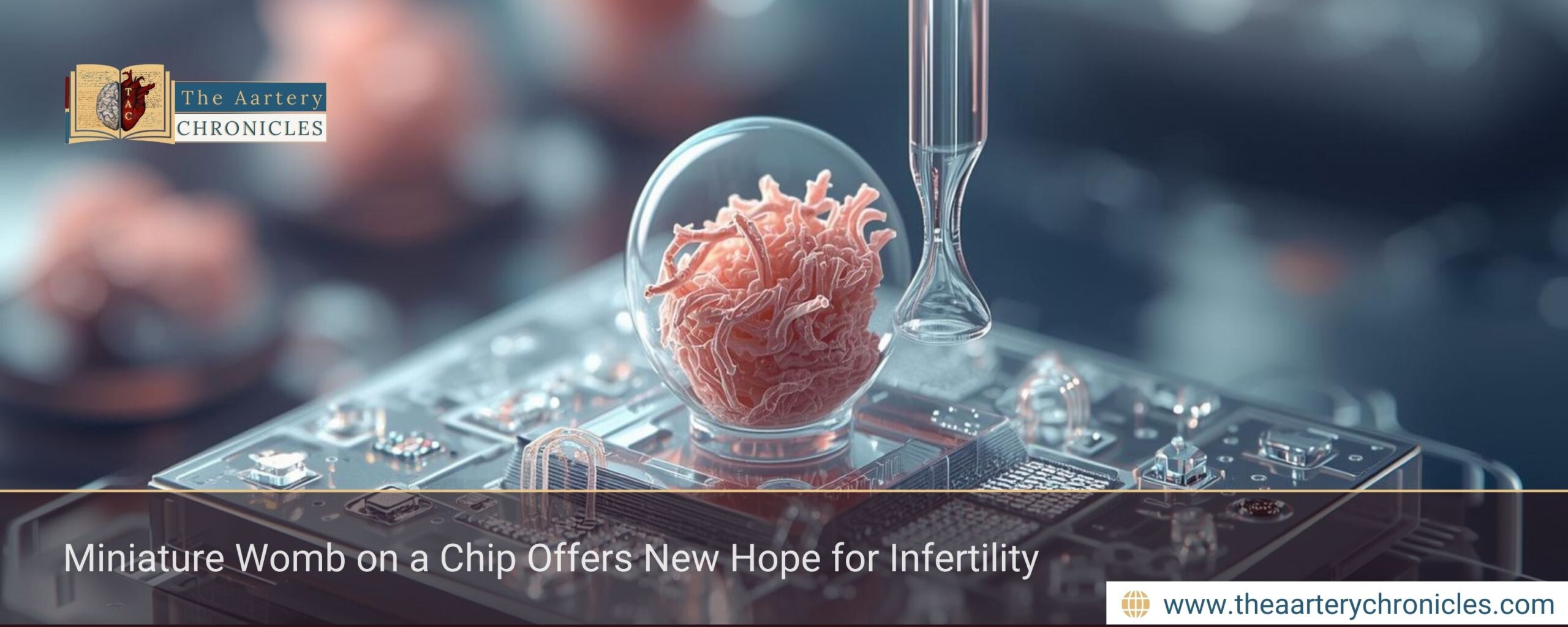
Miniature Womb on a Chip Offers New Hope for Infertility
Scientists have developed a miniature womb on a chip that closely imitates the real human uterus, offering fresh hope to women who face repeated difficulty getting pregnant. This breakthrough allows researchers to observe safely and ethically how an embryo attaches to the womb, a crucial step that determines whether pregnancy can begin.
Developed by researchers at the Chinese Academy of Sciences, the technology could change how infertility is understood and treated, especially for women undergoing IVF who experience repeated implantation failure.
Why embryo implantation matters so much
Pregnancy begins when a fertilized egg attaches itself to the lining of the uterus, usually five to seven days after fertilization. If this attachment, called implantation, does not happen, pregnancy cannot continue.
Unfortunately, implantation is also one of the least understood stages of human reproduction. Doctors cannot directly observe what happens inside a living uterus, and traditional lab models do not fully capture the womb’s complex structure and hormonal environment.
This is where the miniature womb on a chip makes a major difference
What exactly is a miniature womb on a chip?
In simple terms, this technology is a tiny, lab-made version of the uterus built on a microchip.
Here’s how scientists created it:
- Human uterine cells were placed into a soft gel that allows them to grow naturally
- These cells formed 3D tissue structures similar to the uterine lining, known as the endometrium
- The tissue was then housed inside a microfluidic chip that circulates nutrients and hormones, much like blood flow in the body
The result was a living, working uterine environment small enough to fit on a chip yet realistic enough to behave like a real womb.
Testing how embryos implant
To test the model, researchers introduced two types of early embryos:
- Blastoids, which are stem cell–derived structures that behave like early embryos
- Donated human blastocysts, collected with proper ethical approval
Inside the chip, both successfully went through the key stages of implantation, proving that the miniature womb on a chip can accurately recreate early pregnancy events.
Understanding recurrent implantation failure (RIF)
Many women undergoing IVF face Recurrent Implantation Failure (RIF), a condition where healthy embryos repeatedly fail to attach to the uterus.
To explore this, scientists built womb-on-chip models using uterine cells from women with RIF. The results were striking:
- Embryos were far less likely to attach
- Growth was weaker and often stopped early
This closely matched what happens in real-life patients, confirming that the model can reflect individual infertility problems with high accuracy.
A powerful tool for personalized treatment
One of the most exciting findings was the chip’s potential for drug testing.
Using the miniature womb on a chip, researchers screened over 1,000 FDA-approved medications and identified several compounds that improved implantation success. This opens the door to personalized fertility treatment, where doctors could test medications on a patient’s own womb model before prescribing them.
The study was published in the prestigious journal Cell, highlighting its importance to global reproductive medicine.
Conclusion
The miniature womb on a chip represents more than just a lab achievement. It offers:
- A safer way to study early pregnancy
- Better understanding of why implantation fails
- New options for personalized IVF treatments
- Reduced trial-and-error for women struggling to conceive
While this technology is still in the research phase, experts believe it could eventually become a routine part of fertility care, bringing clearer answers and renewed hope to millions of women worldwide.
This tiny chip could make a big difference. By recreating the womb’s environment with remarkable accuracy, the miniature womb on a chip may help doctors unlock one of the biggest mysteries in reproductive medicineand help more families achieve their dream of parenthood.
Source: Inputs from various media Sources

I’m a pharmacist with a strong background in health sciences. I hold a BSc from Delhi University and a pharmacy degree from PDM University. I write articles and daily health news while interviewing doctors to bring you the latest insights. In my free time, you’ll find me at the gym or lost in a sci-fi novel.
- Priya Bairagi
- Health News and Updates,People Forum
- 13 January 2026
- 13:00