
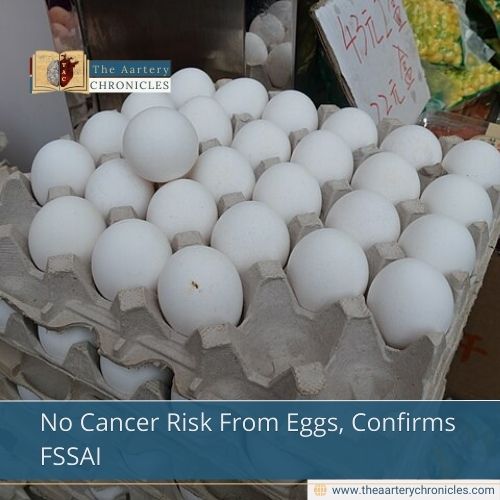

No Cancer Risk From Eggs, Confirms FSSAI
Recent social media posts and short video clips have raised concerns about a no cancer risk from eggs claim, leaving many people confused and worried. To address this, India’s top food regulator, the Food Safety and Standards Authority of India (FSSAI), has issued a clear and science-based statement. In simple terms, FSSAI confirms that eggs sold in India are safe to eat and do not increase cancer risk when consumed as part of a normal diet.
Where Did the Fear Come From?
To begin with, a few online videos showed laboratory reports detecting extremely small traces of AOZ, a by-product of nitrofuran antibiotics. These antibiotics have been banned in poultry farming for years. As a result, some viewers assumed that even tiny traces could cause cancer. Moreover, attention was drawn to a single egg brand, which made the issue look much bigger than it actually was.
What FSSAI Says About These Claims
According to FSSAI, these viral claims are misleading and not supported by medical science. Importantly, nitrofurans are strictly prohibited in poultry production under Indian food safety rules. The commonly mentioned limit of 1.0 microgram per kilogram is only a laboratory detection reference, not a safety allowance.
In other words, when labs detect amounts below this level, it does not mean the food is unsafe or harmful. Therefore, the idea that eggs pose a cancer threat is incorrect. This reinforces the message of no cancer risk from eggs based on current evidence.
What FSSAI Says About These Claims
Furthermore, India’s food safety rules are in line with international practices. Both the European Union and the United States also ban nitrofurans in food-producing animals. Any minor differences in testing numbers are due to laboratory methods, not weaker safety rules. Notably, no global health authority has linked regular egg consumption with cancer.
What Science Really Shows
There is no proven link between eating eggs and cancer in humans. Very low-level detections usually occur due to accidental feed contamination or isolated batches, not widespread problems. Hence, turning single lab results into nationwide warnings creates unnecessary fear rather than protecting public health.
Eggs: Safe and Highly Nutritious
Beyond safety, eggs are nutritional powerhouses. They provide high-quality protein for muscle repair, vitamin B12 for energy, vitamin D for bone health, and lutein for eye protection. Many nutrition experts recommend one to two eggs a day for healthy adults. When eaten with vegetables, fruits, or whole grains, eggs can support heart health, weight control, and stable blood sugar levels, again highlighting no cancer risk from eggs when eaten responsibly.
Simple Tips for Safe Egg Consumption
- Choose fresh eggs from trusted sellers
- Store eggs in a cool place or refrigerator
- Cook eggs thoroughly to prevent bacterial infections
- Balance egg dishes with vegetables, grains, and healthy fats
For personalized advice, it is always wise to consult a doctor or dietitian, especially if you have specific medical conditions.
Conclusion
Official guidance and medical evidence clearly show no cancer risk from eggs. Misinformation can spread quickly online, but trusted scientific authorities like FSSAI help separate facts from fear. Eggs remain an affordable, safe, and nutritious food that can be confidently included in a balanced daily diet.
Source: Inputs from various media Sources

I’m a pharmacist with a strong background in health sciences. I hold a BSc from Delhi University and a pharmacy degree from PDM University. I write articles and daily health news while interviewing doctors to bring you the latest insights. In my free time, you’ll find me at the gym or lost in a sci-fi novel.
- Priya Bairagi
- Health News and Updates,People Forum
- 22 December 2025
- 09:00