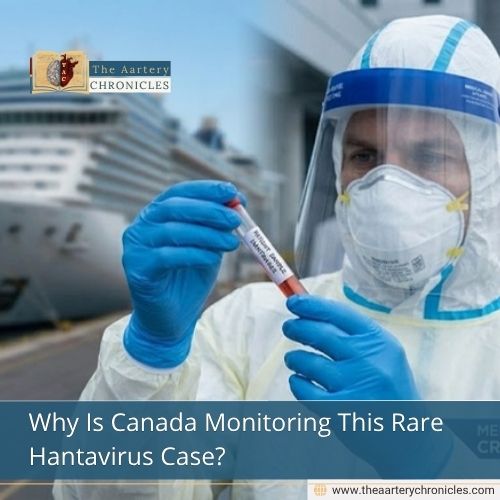

Why Is Canada Monitoring This Rare Hantavirus Case?
Health officials in Canada have confirmed the country’s first case linked to the growing hantavirus outbreak connected to a South American cruise ship. The patient recently returned from a voyage aboard the MV Hondius, a Dutch expedition cruise vessel tied to multiple infections and reported deaths among travelers in Europe.
The development has raised global concern because the outbreak involves the Andes strain of hantavirus, a rare version known to spread between people under certain conditions. At the same time, recent scientific findings about the virus lingering in the human body for years have added fresh questions for researchers and public health experts.
Canada Reports First Confirmed Case
Authorities in British Columbia said the infected passenger returned to Canada earlier this month after traveling on the MV Hondius. The individual later developed mild symptoms, including fever and headache, before being admitted to a hospital in Victoria for isolation and monitoring.
Four Canadians who were on the cruise have now entered quarantine. So far, one person has tested positive for hantavirus.
Canada’s National Microbiology Laboratory in Winnipeg continues to conduct additional testing while health teams trace possible exposures. Officials currently believe the risk to the general public remains low. However, they are maintaining close surveillance because the Andes strain behaves differently from most hantaviruses.
Investigators suspect passengers may have encountered infected rodents during shore excursions in parts of South America where the virus naturally circulates.
What Is Hantavirus?
Rodents are the primary carriers of the hantavirus. People usually become infected after breathing in tiny airborne particles contaminated with rodent urine, saliva, or droppings.
In severe cases, the infection can lead to Hantavirus Pulmonary Syndrome, often called HPS, a dangerous lung condition that may rapidly progress to breathing failure.
- Fever
- Muscle pain
- Fatigue
- Headache
- Nausea
- Chills
As the illness worsens, patients can develop serious breathing difficulty and fluid buildup in the lungs.
Doctors consider hantavirus infections dangerous because mortality rates remain high, especially with the Andes strain involved in the current outbreak.
Why the Andes Virus Is Drawing Attention
Most hantavirus strains do not spread from person to person. However, the Andes virus, found mainly in Chile and Argentina, remains the only known strain capable of limited human transmission.
Researchers have previously documented transmission among close contacts, especially within households and between intimate partners.
That unique feature explains why the current hantavirus outbreak aboard the cruise ship has triggered international concern. Cruise environments often involve prolonged close contact, shared cabins, and confined indoor spaces, conditions that can increase the chance of exposure.
Still, health experts stress that the virus does not spread as easily as respiratory infections like COVID 19 or influenza.
Study Finds Viral Genetic Material Years After Recovery
A recent peer reviewed study has added another layer of concern surrounding the Andes virus.
Scientists at Switzerland’s Spiez Laboratory followed a 55 year old man who contracted hantavirus while traveling in South America. According to the 2023 study, researchers detected Andes virus genetic material in the man’s semen nearly six years after his infection.
The virus had already disappeared from his blood, urine, and respiratory tract during recovery. However, laboratory testing still identified viral RNA in reproductive tissue 71 months later.
Researchers clarified an important point: finding viral genetic material does not necessarily mean a person still carries live infectious virus.
Even so, the discovery has sparked debate about whether sexual transmission could theoretically occur long after recovery.
Medical experts explain that the testes are considered an “immune privileged” area where some viruses may remain hidden from the body’s immune defenses. Scientists have observed similar behavior in infections such as Ebola and Zika.
At present, no confirmed cases of sexual transmission of hantavirus have been reported anywhere in the world.
How Long Can Hantavirus Survive?
Outside the body, hantavirus may survive for several days under favorable conditions, especially in cool indoor environments contaminated by rodent waste.
According to respiratory health experts, the virus can remain active for up to four days depending on temperature and humidity.
Inside the human body, the picture appears more complex. Most patients clear the virus from the bloodstream and lungs after recovery. However, the recent Andes virus findings suggest viral remnants may persist in certain tissues for years.
Scientists caution that lingering RNA does not automatically mean someone remains contagious. Many viral infections leave harmless genetic fragments behind long after the active infection ends.
Even so, researchers say more studies are urgently needed to better understand whether these remnants could play any role in delayed or rare transmission.
Conclusion
Despite growing attention online, infectious disease specialists say the current hantavirus outbreak differs greatly from the COVID 19 pandemic.
Hantavirus spreads far less easily between humans. Most infections still happen after direct exposure to infected rodents or contaminated environments. In addition, outbreaks generally remain small and localized rather than spreading rapidly through communities.
Global health agencies continue to emphasize that rodent exposure remains the primary source of infection worldwide.
However, experts acknowledge that cruise ships and other crowded travel settings may create unusual conditions for transmission, especially when the Andes strain is involved.
For now, Canadian health authorities continue monitoring passengers connected to the MV Hondius while working closely with international agencies to track the outbreak and prevent further spread.
Source: Inputs from various media Sources

I’m a pharmacist with a strong background in health sciences. I hold a BSc from Delhi University and a pharmacy degree from PDM University. I write articles and daily health news while interviewing doctors to bring you the latest insights. In my free time, you’ll find me at the gym or lost in a sci-fi novel.
- Priya Bairagi
- Health News and Updates,People Forum
- 18 May 2026
- 13:00