
Social Prescribing: The New Way to Beat Stress
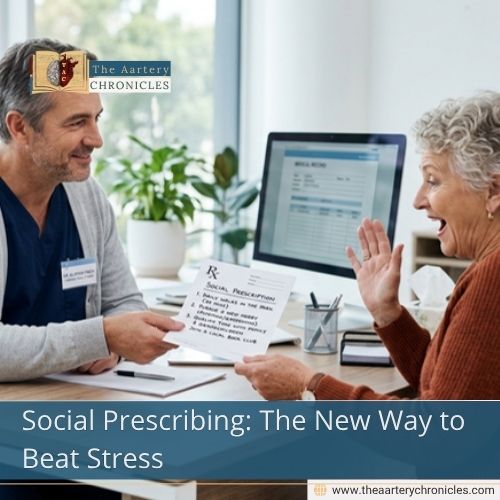
Picture this – you get this weird ache below your shoulders. You have taken medication, but sometimes the pain subsides only to return stronger. X-ray shows all is great. Your physician asks you an unexpected question – “Do you have any stress?” You reply, “Actually, there is a lot of work pressure at the moment, and I am working long hours”. He looks at you thoughtfully and asks, “Are you eating and sleeping well? You reply in the negative. He thinks for a moment and writes you a prescription. “Take this and let me know how you feel in a week”.
You take the prescription and read it in shock, written all over your face. You cannot believe what he has written. You look at him, and he smiles at you. “Trust me”, he says. You nod in disbelief and go home.
At home, you read the prescription once more –
- 30-minute walk in the park every alternate day without any digital device
- Spending 30 minutes with your children every day
- Dinner by 8.30 pm, followed by 50 calf raises
- 20 minutes of playing the harmonica every night
- Join a hobby class at weekends
- Smile a bit more 😊
- Speak with or meet your friends once a week.
Did you even think in your wildest dreams that your doctor would prescribe you such activities? What does this say about us and what we are doing with our lives?
Come to think of it, it sounds weird that you need a doctor advising you to “live” your life. Who is to blame for this? We are so caught up in the rigmarole of life that we cease to think and function like human beings. We are becoming just like machines, going on and on and on and inviting burnout, stress, mental fatigue, lifestyle diseases, mental issues, low self-esteem, low self-confidence, loneliness and other occupational hazards.
What your doctor prescribed is somewhat like social prescribing or community referral.
Origin
This concept of social prescribing began in the UK when medical practitioners found that medication alone could not cure their patients of loneliness, mental health issues, stress of daily life, like repaying loans, acquiring a house, etc., that manifest as physical symptoms like aches, pains, allergies and so on.
What began as informal advice soon became a formal process in the UK with the foundation of Bromley by Bow Centre.
What is Social prescribing?
Social prescribing or community referral involves activities that involve our active participation and mindfulness. Most importantly, we have to make time for these activities, irrespective of our daily routine. Think of it like medication to be taken at a prescribed time, so is the activity that you have to do.
How it works
In social prescribing, the medical practitioner refers the patients to ‘link workers’ who talk to the patients, formulate a non-clinical activity based on the patients’ history, and that is most suited to the patients. The patients are advised about whatever matters are bothering them or stressing them out, like financial advice, housing/loan issues, lifestyle diseases, mental stress, health-related issues, loneliness, empty nest syndrome, trauma, death of a loved one, divorce or any other issues that may be plaguing them.
The link workers monitor the progress and adjust the activity programs, if so required. Notably, there was improvement in the patients and a reduction in their medical trips to the hospital/GP.
A good example is the Bromley by Bow Care Centre in the UK, which was formed in 1984. It provides “link workers” as mentioned above and a host of services related to health and wellness.
The activities
These activities are gardening, fine arts (dance, music, drama), learning a new hobby in a group, cookery, meeting new people, volunteering and the like.
How it helps
Making time for these activities is beneficial in many ways:
- It gives you something to look forward to, something new and challenging.
- It makes you happier and more energetic.
- It makes you interact with strangers.
- It makes you relax and concentrate on that activity for that period of time.
- It calms your mind and soothes your senses.
- It gradually builds up your self-confidence.
- It reduces stress levels, and voila, your nagging aches just poof! disappear.
- It makes you feel your true worth.
- It makes you free!
- It makes you smile more (many of us have forgotten how to smile, I kid you not !), it’s true.
- It helps you look at your problems with a clearer head and find a suitable solution.
- It improves your mental and physical health.
- It improves the quality of your life, you eat better, sleep better and work within limits.
- It prevents burnout.
- It reduces hospital and doctor visits.
- It helps you age better.
- It improves your interpersonal relationships.
On a healthy note, these activities keep your blood pressure and blood sugar manageable, stress levels reduce, aches and pains vanish, no more insomnia, no more indigestion or stomach issues, and no more pain! People who are lonely or shy begin to come out of their shells and socialize.
Unlocking the prescription
Let us understand the prescription:
- 30 minute walk in the park will increase your interaction with other people there.
- 30 minutes with your children will make you feel like a child and relax.
- Early dinner and calf raises will keep your digestion better, help to manage sugar spikes.
- 20 minutes of harmonica will make you forget all the stress of the day and relax you. (You can play any musical instrument of your choice.
- Hobby class during weekends makes you meet new people and form connections.
- Smiling more tells your mind that you are happy, and you automatically feel good.
- Speaking or meeting up with friends relaxes you and keeps you happier.
It is sad but true that we need a prescription to make us happy.
Let us stop for a moment and think, is being in the rat race worth it? Is it worth the family functions missed? The child’s first walk? The meal was prepared with so much love, but was never eaten due to overtime at work. Is the bitterness in the relationships due to a lack of family time? The aloofness of the children? the rushing to work and forgetting it was your turn to drop your child off at school? Doesn’t it make you feel lost, withdrawn, inadequate, or incomplete? Is money going to buy all these missed, priceless moments?
Conclusion
So, the moral of the story is that we do not want our doctors to give us such prescriptions. Let us re-learn how to live our lives before it is too late. Let us maintain our relationships with love and affection; let us care for ourselves mentally, emotionally, physically, and spiritually. Let us live and feel alive!
Cheers to life. We have just one life. You do the math!
Source: Inputs from various media Sources
- Rupal Sonpal
- Health News and Updates,People Forum
- 4 April 2026
- 11:00