
What Causes Goosebumps and Why They Still Matter
Goosebumps are something almost everyone experiences, yet few people stop to wonder why humans get goosebumps in the first place. Whether it happens on a cold morning, during an emotional song, or in moments of awe or fear, this tiny skin reaction feels automatic and mysterious. Long believed to be a leftover from human evolution with no real purpose today, goosebumps are now proving to be far more meaningful, especially for skin and hair health.
What Exactly Causes Goosebumps?
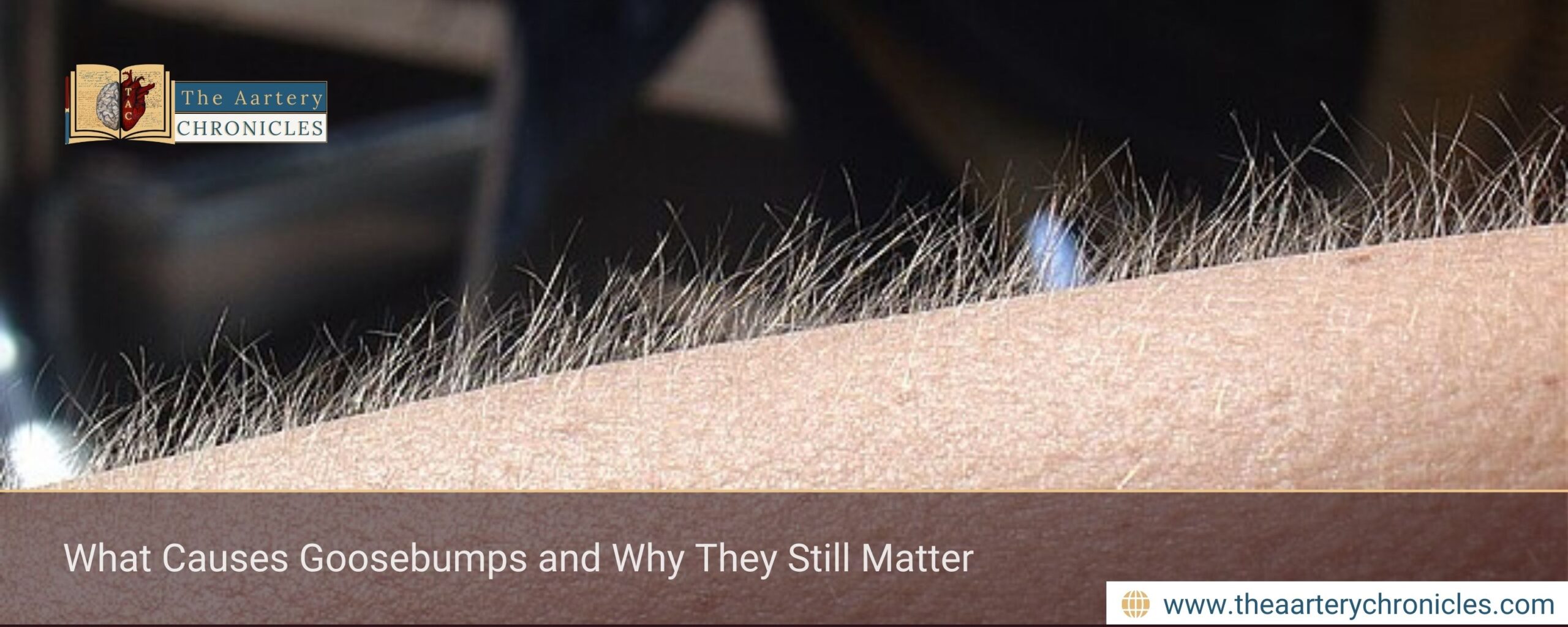
In medical terms, goosebumps are called cutis anserina. They occur when very small muscles in the skin, known as arrector pili muscles, suddenly contract. These muscles are attached to hair follicles across most parts of the body.
When they tighten, they pull the hair follicle upward. This action creates the familiar bumpy appearance on the skin that we commonly call goosebumps. Importantly, this response is completely involuntary.
The trigger comes from the sympathetic nervous system, the same system responsible for the body’s “fight-or-flight” response. This explains why goosebumps can appear not only in cold weather but also during moments of fear, excitement, or intense emotion.
How Goosebumps Helped Early Humans Survive
To understand why humans get goosebumps, it helps to look back at our evolutionary past.
Early humans had much thicker body hair than we do today. When arrector pili muscles contracted, the raised hair trapped warm air close to the skin, providing extra insulation in cold environments. The muscle contraction itself also produced a small amount of heat.
In addition, raised hair may have made early humans appear larger and more intimidating, much like animals that puff up their fur when threatened. This defensive visual effect aligns closely with the fight-or-flight response, reinforcing the idea that goosebumps once played a role in survival.
Why Do Emotions Trigger Goosebumps?
Many people notice goosebumps during powerful music, moving speeches, or moments of deep awe. This emotional response happens because the brain regions that process strong feelings are closely connected to the sympathetic nervous system.
In simple terms, the body reacts to emotional intensity in a similar way it reacts to physical danger or cold. As a result, goosebumps are not just a physical reaction; they are also a reflection of our emotional wiring, deeply rooted in human biology.
A Surprising Role in Skin Health
Beyond temperature and emotion, goosebumps may support skin health in subtle but important ways.
The arrector pili muscles sit close to sebaceous glands, which produce sebum, an oily substance that keeps the skin moisturised and protected. When these muscles contract, they gently stimulate the glands, helping release sebum onto the skin’s surface. This process may assist in maintaining skin hydration and preventing excessive dryness.
New Research Links Goosebumps to Hair Growth
Recent scientific findings have added another unexpected layer to the story of why humans get goosebumps.
A 2020 study published in Cell found that in mice, contraction of the arrector pili muscles sends signals that activate dormant hair follicle stem cells. This activation encourages new hair growth, suggesting that the goosebump mechanism may still play an active biological role rather than being a useless evolutionary remnant.
While more research is needed to confirm how this applies to humans, the discovery highlights a potential link between goosebumps and long-term hair follicle health.
Conclusion
What was once dismissed as a “useless” body reaction is now gaining recognition for its ongoing relevance. Goosebumps are not just a quirky response to cold or emotion; they are part of a complex system tied to temperature control, emotional processing, skin protection, and possibly even hair regeneration.
Understanding why humans get goosebumps reminds us that the human body often retains ancient mechanisms for good reason, some of which science is only beginning to fully appreciate.
Source: Inputs from various media Sources

I’m a pharmacist with a strong background in health sciences. I hold a BSc from Delhi University and a pharmacy degree from PDM University. I write articles and daily health news while interviewing doctors to bring you the latest insights. In my free time, you’ll find me at the gym or lost in a sci-fi novel.
- Priya Bairagi
- Health News and Updates,People Forum
- 22 January 2026
- 13:00