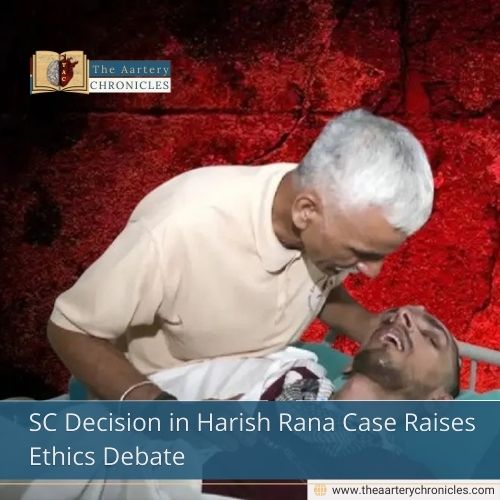

SC Decision in Harish Rana Case Raises Ethics Debate
A recent decision by the Supreme Court has brought national attention to the Harish Rana right to die with dignity case, a deeply emotional legal battle that lasted for more than a decade. The court allowed the withdrawal of life-sustaining treatment for a 32-year-old man who had remained in a permanent vegetative state for 13 years after a severe accident.
The judgment has reopened public discussion about end-of-life medical care, passive euthanasia, and the meaning of dignity in prolonged illness.
Who Was Harish Rana?
Harish Rana was a young student whose life changed dramatically after a tragic accident in 2013. He fell from the fourth floor of a building in Chandigarh and suffered serious brain injuries.
Doctors later confirmed that the injury caused extensive brain damage. As a result, Rana developed quadriplegia and entered a permanent vegetative state. He never regained consciousness after the accident.
At the time of the incident, he was still pursuing his education. However, the injury left him completely dependent on medical support.
Medical teams assessed his condition as irreversible. They recorded 100 per cent disability and stated that recovery was extremely unlikely.
Living on Medical Support for More Than a Decade
For over thirteen years, Harish Rana survived through clinically assisted nutrition and hydration. Doctors provided food and fluids through feeding tubes because he could not swallow on his own.
He could not move, communicate, or respond to his surroundings in any meaningful way.
Meanwhile, his elderly parents cared for him throughout this long period. They managed his medical needs at home and in hospitals despite heavy emotional and financial pressure.
Later, the Supreme Court acknowledged the family’s dedication and described their care as selfless.
Why the Family Approached the Court
After many years without improvement, Rana’s parents decided to approach the courts. They argued that their son had no realistic chance of recovery and remained alive only because of artificial medical support.
Therefore, they requested permission to withdraw the feeding tubes that sustained him.
However, the request raised an important legal question. Some authorities initially argued that removing feeding tubes could cause death through starvation. Because of this, the act might resemble active euthanasia, which remains illegal in India.
Rana’s family, however, maintained that clinically assisted nutrition and hydration should count as life-sustaining medical treatment. If that interpretation applied, doctors could withdraw it under the rules for passive euthanasia.
Supreme Court Decision in the Harish Rana Right to Die With Dignity Case
On March 11, 2026, a bench of the Supreme Court consisting of Justices JB Pardiwala and KV Viswanathan delivered its final verdict in the Harish Rana right to die with dignity case.
The court allowed Rana’s parents to discontinue life-sustaining treatment after careful medical review.
The judges explained that the key issue was not whether death would benefit the patient. Instead, the court asked whether continuing treatment truly served the patient’s best interests.
The ruling relied on the Supreme Court’s earlier 2018 judgment in the Common Cause case. That decision recognised the right to die with dignity as part of the right to life under Article 21 of the Constitution.
In addition, the court clarified that clinically assisted nutrition and hydration can qualify as life-sustaining medical treatment. Therefore, doctors may withdraw it under strict safeguards when a patient remains in an irreversible vegetative state.
Why This Judgment Matters for Medical Ethics
The Harish Rana right to die with dignity case carries important implications for both medicine and law in India.
First, it provides clearer guidance for doctors and courts when dealing with patients who remain in prolonged vegetative states.
Second, it strengthens the legal understanding that dignity remains important even at the end of life.
Finally, the decision highlights the difficult choices families face when caring for loved ones with severe brain injuries. In many cases, medical technology can keep the body alive even when recovery becomes impossible.
Because of this ruling, future courts may find it easier to consider requests for withdrawal of life-sustaining treatment after a thorough medical evaluation.
Conclusion
Harish Rana’s life story reflects more than a tragic accident. It also represents a broader debate about suffering, dignity, and the limits of modern medical intervention.
Through the Harish Rana right to die with dignity case, India now faces renewed discussion about how the healthcare system should approach long-term vegetative states and end-of-life care.
For many families and medical professionals, the case serves as a reminder that compassion, ethics, and law often intersect during the most difficult moments of healthcare decision-making.
Source: Inputs from various media Sources

I’m a pharmacist with a strong background in health sciences. I hold a BSc from Delhi University and a pharmacy degree from PDM University. I write articles and daily health news while interviewing doctors to bring you the latest insights. In my free time, you’ll find me at the gym or lost in a sci-fi novel.
- Priya Bairagi
- Health News and Updates,People Forum
- 12 March 2026
- 13:00