

8-Year-Old Survives Leopard Attack After Rare Surgery
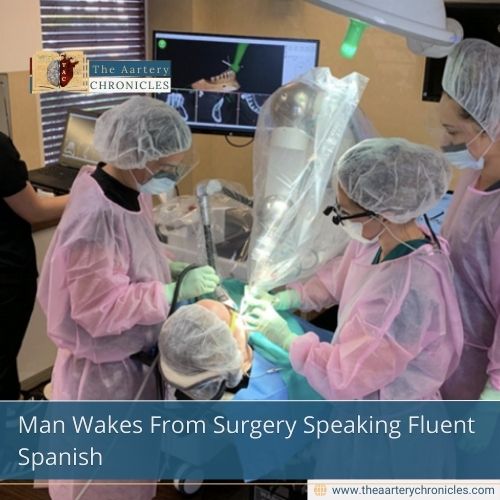
A rare and puzzling medical event has drawn public attention after a man from the United States repeatedly woke up from surgery speaking fluent, native-level Spanish, even though he previously knew only a few basic words. Doctors say the unusual episodes may be linked to Foreign Language Syndrome, an extremely rare neurological phenomenon.
This case highlights how the brain can temporarily access hidden language abilities under certain medical conditions, raising fresh questions about memory, anaesthesia, and language processing.
A Surprising Awakening After Surgery
The man, now in his early 30s, first experienced the sudden language change at age 19 after undergoing knee surgery for a sports injury. When he regained consciousness, nurses noticed something unexpected: he was responding entirely in Spanish.
Before that operation, his Spanish knowledge was minimal. He could count to ten and say a few simple phrases, but he had never been fluent. Yet, for about 20 minutes after surgery, he spoke Spanish smoothly and confidently before gradually switching back to English.
At the time, he was confused and had little memory of the event itself. Medical staff had to repeatedly ask him to speak English, which only added to his disorientation.
A Pattern That Repeated Over the Years
What seemed like a one-time incident soon became a recurring pattern. After several later surgeries, including procedures for sports injuries and a nasal operation, the same thing happened again.
Each time, he woke from anaesthesia, answering questions in Spanish. Nurses would ask how he felt or whether he was in pain, and he would respond clearly but not in English. In his mind, he believed he was speaking normally and could not understand why others looked confused.
These episodes typically lasted less than an hour and then resolved on their own. Because the pattern became predictable, he now warns healthcare teams so they are not caught off guard.
Exposure Without Fluency
Importantly, the man was not raised bilingual. However, he grew up around Spanish-speaking friends and neighbours and heard the language frequently during childhood. While he did not actively speak Spanish, his brain was repeatedly exposed to it.
Later in life, he spent time abroad, which improved his second-language skills. Still, he says the post-surgery fluency felt very different, far beyond his everyday ability.
This has led doctors and researchers to consider how passive exposure and long-term
storage might play a role in Foreign Language Syndrome.
What Is Foreign Language Syndrome?
Foreign Language Syndrome is a rare neurological condition in which a person suddenly and involuntarily switches from their native language to another language they previously learned. Unlike better-known speech disorders, the person does not develop an accent; the entire language changes.
Medical reports suggest this condition may occur after:
- General anesthesia
- Head injuries
- Stroke or brain bleeding
- Brain tumors
- Severe psychological stress
Some experts believe it may be related to temporary brain confusion during recovery from anaesthesia, also known as emergence delirium. However, the exact cause remains unclear.
Why This Case Is So Unusual
Only a handful of confirmed cases of Foreign Language Syndrome have been documented worldwide. Most involved a single episode following a medical or neurological event.
What makes this case stand out is that the language switch has happened repeatedly over more than a decade, and after different surgeries. Despite its dramatic nature, doctors note that the condition appears temporary and does not cause lasting brain damage.
While the condition is extremely rare, this case offers reassurance. People who experience Foreign Language Syndrome usually recover fully, with no long-term effects on speech or memory.
For researchers, it serves as a reminder of how complex and still-mysterious the human brain can be, especially when influenced by anaesthesia and altered states of consciousness.
Conclusion
Foreign Language Syndrome may sound unbelievable, but cases like this show it can happen. Although rare, it demonstrates the brain’s hidden capacity to store and retrieve information in unexpected ways, sometimes surfacing when we least expect it.