
Down Syndrome: Causes, Signs, Diagnosis & Key Facts
Summary: This article explains Down syndrome (Trisomy 21), its causes, types, symptoms, diagnosis, developmental outcomes, and health challenges. It also covers prenatal screening, physical features, associated medical conditions, and the likelihood of recurrence. A short Q&A quiz is included at the end to reinforce key facts.
Did you know that Down syndrome (Trisomy 21) is the most common chromosomal disorder worldwide, affecting approximately 1 in every 800 births?
In this article, you will learn what Down syndrome is, why it occurs, its physical and developmental features, screening and diagnostic methods, health risks, and finally a fun Q&A quiz to test your knowledge.
What Is Down Syndrome?
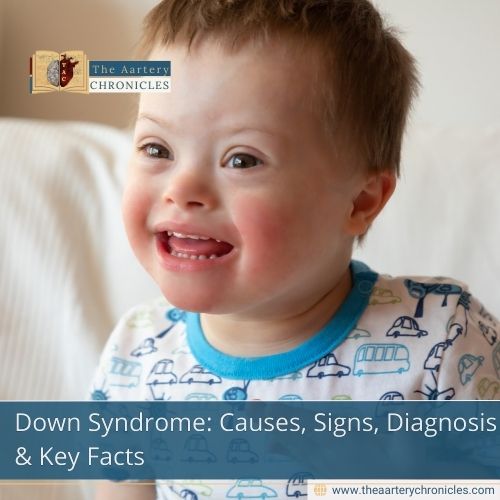
Down syndrome, also known as Trisomy 21, is a genetic condition caused by the presence of an extra copy of chromosome 21, either fully or partially. This additional genetic material alters development and leads to
- Distinct physical features
- Developmental delays
- Mild-to-moderate intellectual disability
People with Down syndrome often have strong emotional intelligence, warm social behaviour, and high adaptive skills despite cognitive challenges.
Prenatal Detection and Screening
Down syndrome can be identified:
- During pregnancy
- Through prenatal screening tests (combined screening, NIPT)
- Followed by confirmatory diagnostic tests like CVS or amniocentesis
- After birth
- Through clinical observation and genetic karyotyping
Since widespread screening began, many Down syndrome pregnancies are terminated, with abortion rates ranging from 50% to 85% based on
- Maternal age
- Gestational age
- Ethnicity
Developmental and Cognitive Profile
People with Down syndrome:
- Reach developmental milestones later than peers.
- Typically achieve cognitive abilities similar to an 8–9-year-old child in adulthood.
- Show excellent emotional and social awareness.
- Have an increased risk of:
- Congenital heart defects
- Epilepsy
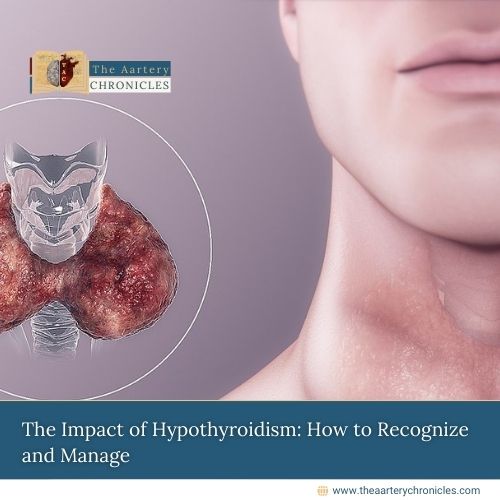
- Thyroid disorders (often hypothyroidism)
- Dementia/early-onset Alzheimer’s
- Recurrent infections due to lower immunity
Individuals with mosaic Down syndrome generally have better developmental outcomes.
Physical Features of Down Syndrome
Common characteristics include:
- Small chin
- Epicanthic folds (folds of skin near the eyes)
- Flat nasal bridge
- Low muscle tone (hypotonia)
- A protruding tongue (due to weak facial muscles)
- Excessive joint flexibility
- Single palmar crease
- Larger gap between the big toe and the second toe
- Short fingers
Additionally, around 50% have Obstructive Sleep Apnea (OSA) due to structural airway differences.
Diagnosis After Birth
A classical diagnostic tool once used was a 25-sign physical examination checklist:
- Using the total number of signs present, Trisomy 21 could be predicted in ~50% of suspected cases.
- A more refined approach using the 10 most informative signs misclassified only 11 out of 169 infants under age 2.
- Nearly 75% of suspected cases could be clearly classified.
- Risk in the overlap zone was 58%.
Today, karyotyping is the gold standard for diagnosis.
Why Does Down Syndrome Occur?
An extra copy of genes causes Down syndrome on chromosome 21. Parents are usually genetically normal, and the condition typically arises because of a random error during cell division.
Parents who have had one child with Down syndrome have around a 1% chance of recurrence if their karyotypes are normal.
Three Types of Down Syndrome
- Trisomy 21 (94%)
Entire extra chromosome 21 in all cells - Translocation (4%)
Extra chromosome 21 material attaches to another chromosome - Mosaic type (2%)
Only some cells carry the extra chromosome
Education and Life Expectancy
- In the U.S., about 40% of individuals with Down syndrome graduate high school.
- Many learn essential reading and writing skills.
- About 20% can do paid work as adults.
Life expectancy has greatly improved but remains lower than the general population.
Cultural Note
The movie “Taare Zameen Par 2” portrayed Down syndrome, increasing public awareness and encouraging more people to understand the condition and its challenges.
Let’s Make Learning Fun: Down Syndrome MCQ Quiz
(Correct answers marked in red below)
1. Estriol level in Down syndrome?
A – No change
B – Low
C – Elevated
D – Double/Triple
2. All are true regarding Down syndrome EXCEPT?
A – Intellectual disability
B – Brushfield spots
C – Microcephaly
D – Hypothyroidism
3. Recent marker of Down syndrome?
A – hCG
B – Alpha-fetoprotein
C – Inhibin A
D – Estriol
4. All are seen in Down syndrome EXCEPT?
A – Low IQ
B – Brachycephaly
C – Umbilical hernia
D – Hypothyroidism
Conclusion: Understanding Helps Build Inclusion
Down syndrome is not just a genetic condition, it is a unique developmental journey marked by challenges, strengths, and remarkable resilience. With early interventions, special education, medical care, and community support, individuals with Down syndrome can lead meaningful and fulfilling lives.